
Shopping Cart
- ENdynamics Staff
- Spotlight
- Barton I-400X, Convertible Chair
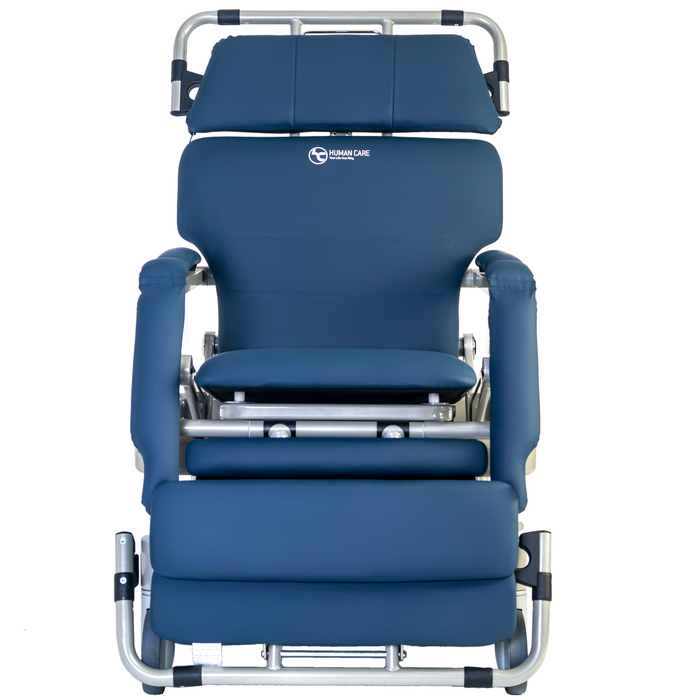
The most immediately useful feature of the Barton I-400X is the stretcher-to-chair conversion itself. The I-400X can be transformed from a flat, supine stretcher into an upright mobile chair in a matter of seconds, without needing a hoist or a second caregiver in most cases.
For nurses and OTs working with patients who have limited mobility, complex positioning needs, or higher body weight, the I-400X combination addresses several recurring clinical problems at once.
This matters clinically because the moment of transfer is where most patient handling injuries occur, both to patients (skin shear, falls) and staff (musculoskeletal injury from lifting). By letting one caregiver move a patient from bed to stretcher to seated position within the same device, the chair removes several handling steps where things typically go wrong. For wards managing bariatric patients specifically, this also removes the awkward moment of trying to source a hoist rated for the patient's weight, since the I-400X itself is rated for use up to 181kg/28.5 stone.
Tilt-in-Space is the second major clinical feature, and it's worth explaining properly rather than assuming familiarity, since it's often confused with simple recline. A standard reclining chair changes the angle between the seat and backrest, which shifts the patient's weight and can increase shear force on the sacrum and heels. Tilt-in-Space instead rotates the whole seating system as one unit, so the angles at the hips, knees, and ankles stay constant while the patient's overall orientation changes. Clinically, this means you can reposition a patient to relieve pressure, manage postural hypotension, support respiratory function, or simply give them a rest position, without disturbing whatever seating and positioning setup an OT has already established for them. For patients with contractures, spasticity, or complex postural needs, that stability of joint angle is often the deciding factor in whether a chair is usable at all.
The chair also has tilt-forward assistance, which supports the opposite end of the mobility spectrum: patients who are being encouraged toward standing and independent movement rather than staying seated. Rather than needing staff to physically assist a patient forward and up, the chair's forward tilt shifts the patient's centre of gravity to make standing easier and less effortful, both for the patient and for the person supervising the transfer. This is particularly relevant for early mobilisation protocols post-surgery or post-stroke, where getting patients upright and moving as soon as safely possible is linked to better outcomes, but where staff are often reluctant to attempt it because of handling risk.
In Acute environments, lateral transfer capability rounds out the transfer functionality. Used with a n optional Patient Transfer System (PTS), the I-400X allows a patient to be moved in a supine position directly across, rather than lifted, which is the safest way to move patients who cannot assist with their own transfer at all, including unconscious, sedated, or severely de-conditioned patients. This is where the "no-lift" positioning of the product is most literal.
From an infection control and practical maintenance standpoint, the chair's upholstery is antimicrobial and breathable, and is designed to be wiped down and di-sinfected quickly between patients. On a busy ward or in a rental fleet situation, turnaround time between uses matters, and a surface that doesn't need prolonged downtime for cleaning is a genuine operational benefit, not just a marketing point.
Height adjustability and castors round out the ergonomic side. Because the whole frame height adjusts, caregivers of different heights can work at a safe posture rather than bending, and the castors allow the chair to be manoeuvred without needing to lift or reposition the patient separately from the chair itself.
Taken together, the clinical case for the I-400X is really about consolidation: instead of a ward needing a stretcher, a tilt-in-space chair, a standing aid, and a separate transfer sheet system, one device covers most of that ground for patients up to bariatric weight limits. For OTs and physios, the constant joint angles under tilt make it easier to maintain a seating plan across different care activities. For nursing staff, the reduced need for manual handling and multi-person lifts is the more immediate day-to-day benefit, and it's the kind of thing that tends to show up in reduced handling-related sick days and incident reports over time rather than in any single dramatic moment.
